The choice that changed everything
On the morning of April 16, 2018, Otto had a severe coughing fit from undiagnosed pneumonia. Soon after, he showed signs of a stroke. Clyde rushed him to the emergency room at St. Joseph’s Hospital, and he was later airlifted to Grady Memorial Hospital.
At Grady, the neurologist explained Otto’s options. Without intervention, Otto likely would not survive. Surgery offered a chance to restore circulation to his brain, but there was a risk of significant impairment.
“I said, ‘Do it,’” Clyde recalls. “I wanted him to have the best chance.”
Amid uncertainty, humor surfaced in an unexpected way.
While Otto was still hospitalized, Clyde got a call from a friend at a local cemetery about the burial plots they’d requested years before. Clyde replied, “That’s wonderful, and the timing couldn’t be better, because I think we’re going to need one this week.”
The caller was horrified. Otto and Clyde still laugh about it now. “It struck me as darkly funny,” Clyde says. “I use that story to test people’s sense of humor.”
Otto survived the surgery. After 10 days at Grady, he transferred to Shepherd Center for inpatient rehabilitation. Together, Otto and Clyde began again.
Recovery as a shared practice
At Shepherd Center, rehabilitation became something they took on side by side. Clyde stepped into the role of care partner as physical, occupational, and speech therapy filled nearly every day.
There were setbacks, long hours, and a kind of exhaustion that only someone navigating a traumatic injury alongside a loved one can truly understand.
“They had these wonderful mats,” Clyde recalls. “They’d be working with Otto in one corner, and I’d pass out on another because I was so tired. They called me ‘The Sleeper.’”
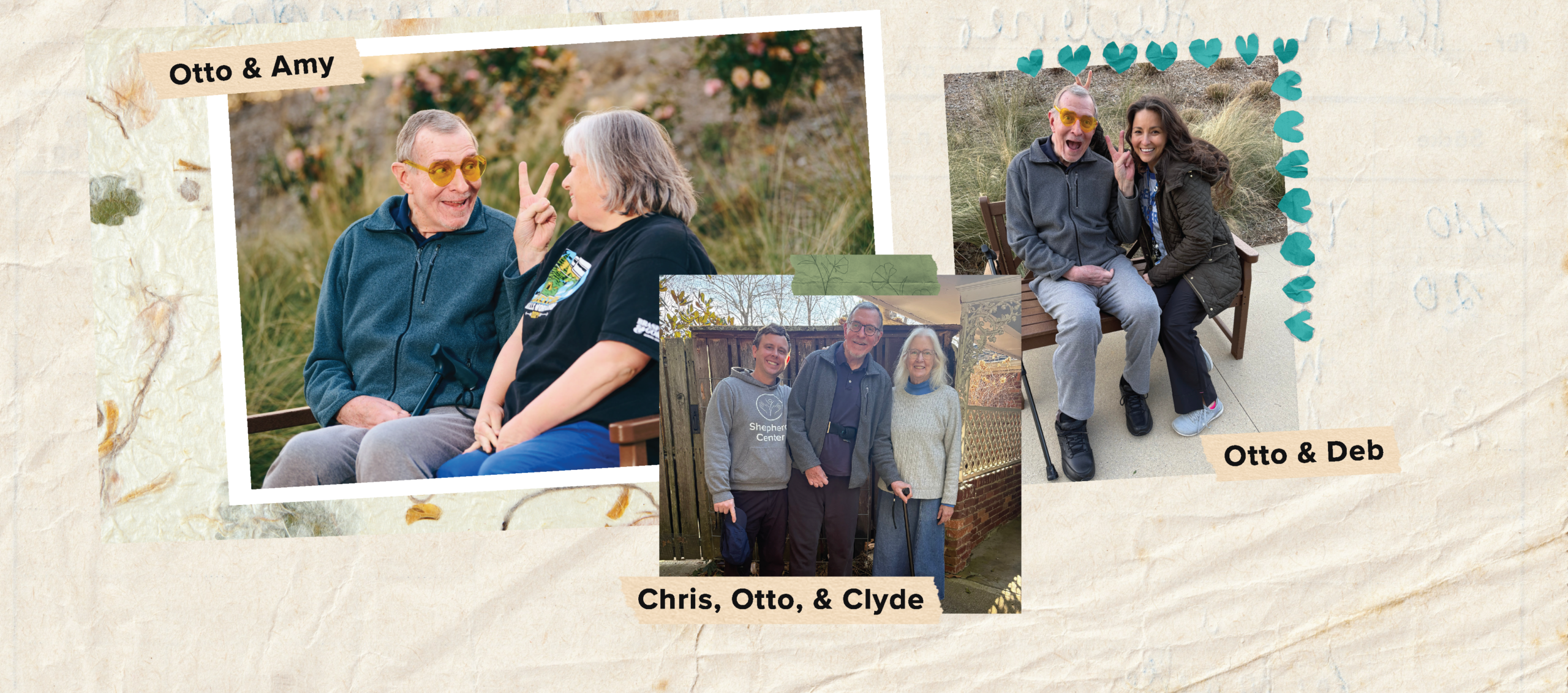
Through it all, the care team supported not only Otto, but also Clyde. Therapists like speech pathologist Amy Waite offered expertise, encouragement, and steadiness on days that felt especially heavy, helping to create space for something just as important as progress: humor.
“Otto had a great sense of humor through all of the frustrations related to not being able to talk,” Amy recalls.
“One session we were working on saying simple words, and he had easily said “beep.” For the next word, he was stuck on “beep.” We worked hard to get the sounds together. He screwed up his face, made a fist, and brought it down on the table trying to say the next word only to very loudly say “beep” again! We both burst out laughing hysterically and had the whole gym wondering what was wrong with us!”